Understanding Your TDPUD Bill
We know utility bills can be complicated, so we've created a guide that breaks down your TDPUD electric and water bills, so you can understand exactly what you're paying for.
Below you'll find definitions for different parts of your bill. Match up the letter in the picture with its corresponding description to learn about that section.

General Account Information

A. Service: Lists the utility services provided to your account by TDPUD. Customers can receive both electric and water service, electric only, or water only. Most customers are both electric and water customers.
B. Rate: This is where you can find the rate class associated with your account.
- For residential water rates, the rate class is based on the size of the TDPUD service to the home (1/2”, 3/4", etc).
- For residential electric rates, TDPUD provides two rates:
- Permanent Resident Rate (P10): billed to those customers who occupy their homes on a full-time basis.
- Non-Permanent Resident Rate (S10): billed to those customers who occupy their homes on a part-time basis for vacations, weekends, ski leases, etc.
Usage Measurements

C. Meter Readings Previous (Prev): Provides the beginning meter reading for water (in gallons) and/or electric (in kilowatt hours (kWh)) for the billing period.
D. Meter Readings Present (Pres): Provides the ending meter reading for water (in gallons) and/or electric (in kilowatt hours (kWh)) for the billing period.
E. Usage: Provides the total usage for water (in gallons) and/or electric (in kilowatt hours (kWh)) for the billing period. This is calculated by subtracting the Previous Meter Reading from the Present Meter Reading.
Electric Bill Information

F. Customer Charge: This is a fixed cost used to fund the operation and maintenance of TDPUD’s electric distribution system. All electric utility customers pay a customer charge to fund critical infrastructure such as electric substations, protective equipment, and distribution facilities.
G. Energy Charge: This charge accounts for the procurement, transmission and delivry of energy from its generation source to our distribution system. It is determined by customer usage per kilowatt hour, which is calculated by multiplying the billing period usage in kilowatt hours (kWh) by the electric rate ($/kWh).
H. Power Cost Adjustment: This allows electric bills to reflect changes in energy procurement costs, in order to adapt to short-term price changes in real time, without requiring a permanent rate change. This could result in either a charge or a credit. The PCA is calculated and implemented quarterly.
I. CA State Surcharge Tax: This California tax is calculated by multiplying the billing period usage in kilowatt hours (kWh) by the current tax rate ($/kWh).
J. Conservation Program Charge: This charge is required by California law, to support energy conservation programs. 2.85% of your electric bill is allocated to fund customer conservation programs. This is not an additional charge to the customer. This is shown on your bill to explain what amount of your total bill is being put towards energy conservation and efficiency programs managed by TDPUD.
Water Bill Information
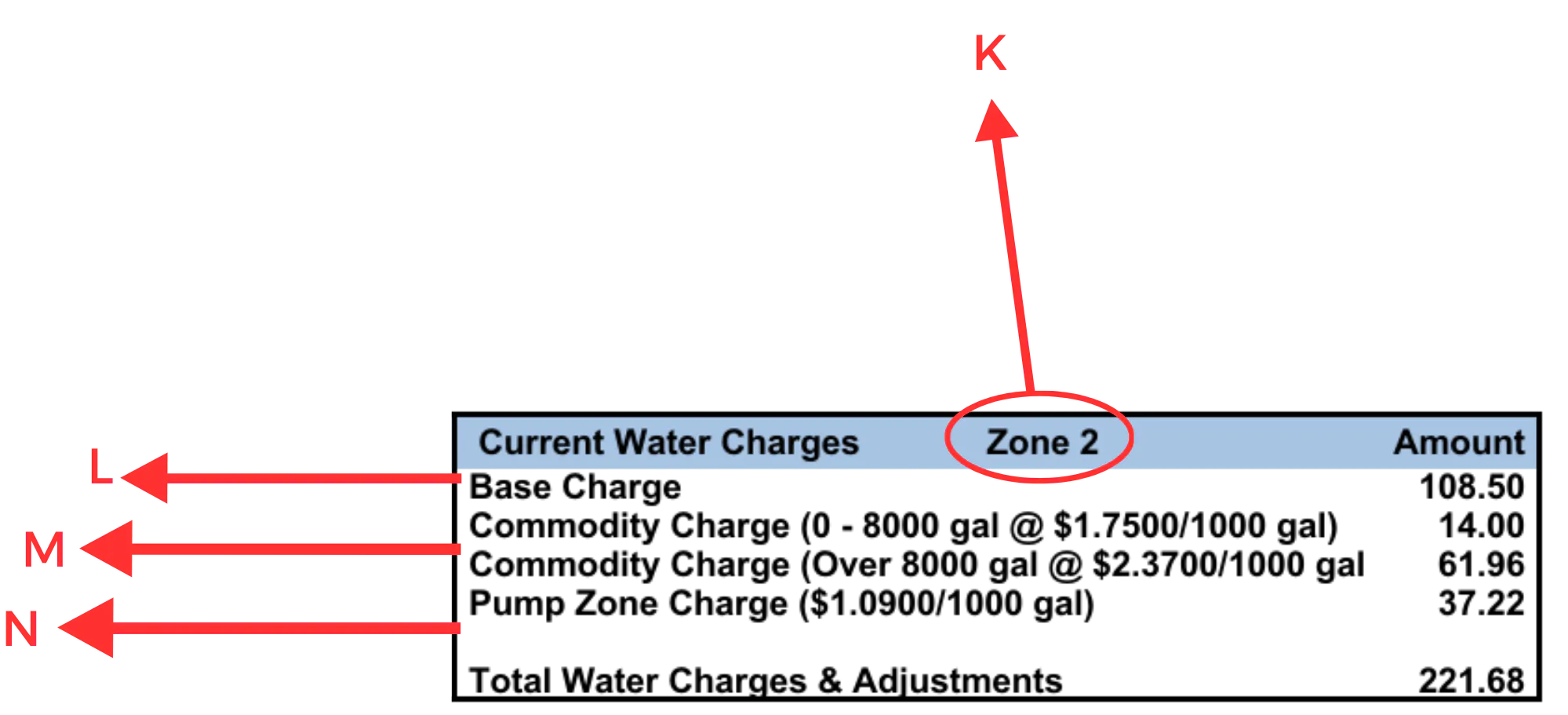
K. Pump Zone: This lists the pump zone where your account is located. There are seven pump zones in TDPUD's system, and they are segmented by elevation. See "Pump Zone Charge" below for more information.
L. Base Charge: This is a monthly fixed service charge that covers operational costs, maintenance and administrative expenses. All water utility customers pay a base charge to fund critical infrastructure, such as pump facilities, pipelines and hydrants. For TDPUD, our cost of service analysis documents that ~85% of water costs are fixed.
M. Commodity Charge: This is based on what it costs to produce water from the source, so it is measured by the amount of water you use. This charge is calculated by multiplying the billing period usage in gallons (gal) by the commodity rate ($/1,000 gal).
For residential customers, there are two pricing tiers:
- 0 – 8,000 gallons per month usage: If you use less than 8,000 gallons per month, you will be billed at $.00175/gallon (or $1.75 per 1,000 gallons).
- 8,000+ gallons per months usage: If you use more than 8,000 gallons, you will be billed at $.00237/gallon (or $2.37 per 1,000 gallons).
N. Pump Zone Charge: This accounts for the energy costs of pumping water to your specific location, particularly if you are in a higher elevation zone. It makes this cost equitable, so people who live at lower elevations are subsidizing the cost it takes to serve higher elevation homes.
This charge is calculated by multiplying the billing period usage in gallons (gal) by the Pump Zone Charge ($/1,000 gal). There are seven total pump zones and the increases between pump zones are incremental. Pump Zone 1 does not pay a pump zone charge. Pump Zone 7 pays $.00648/gallon (or $6.48 per 1,000 gallons).
How Do Our Rates Compare?
Water Rates
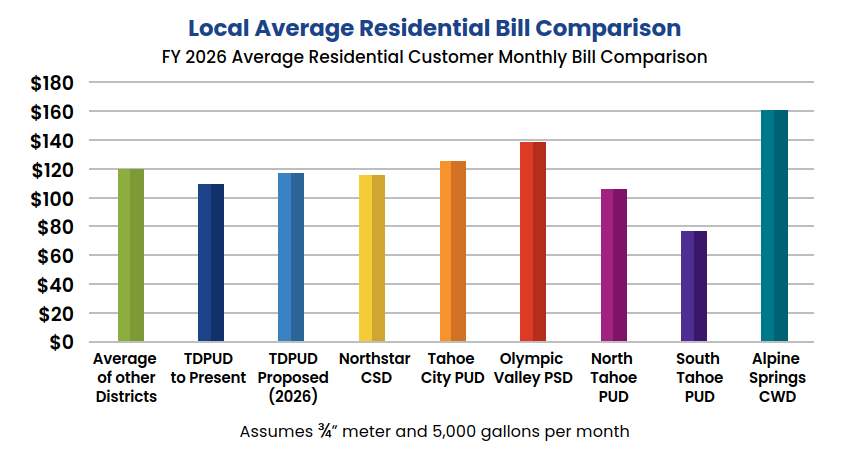
Our water rates are in alignment with the average rates of neighboring public utilities in the Truckee-Tahoe region, and other local water utilities have announced comparable or higher rate increases for the next few years. A typical household using 5,000 gallons per month will see average costs in line—or lower—than the regional average.
Additionally, TDPUD does not receive any property tax dollars. Some agencies included in the below graph do receive property tax funds, which subsidizes their water rates.
Electric Rates
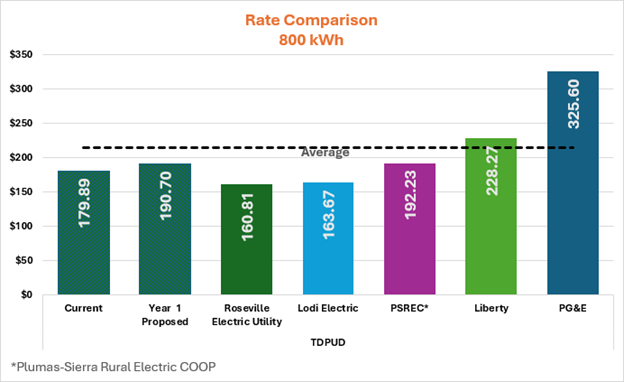
Our electric rates are in alignment with the average rates of regional public utilities in California and below the Investor Owned Utilities (IOUs). In addition, the average 5% rate increases for 2026 and for 2027 are well below other electric utility rate increases.
Additionally, the IOU rate increases listed in the below table only include approved rate increases by the California Public Utility Commission. Both Liberty Utilities and PG&E have significant rate cases pending with the CPUC.